State of agent buyability: October 2026
ARC's first Index data report. Of 83 stores scored in October 2026, 31 had all five ARC browser cart shoppers add the product to the cart, 21 had none, and 14 of those 21 still returned an agent checkout link over HTTP.
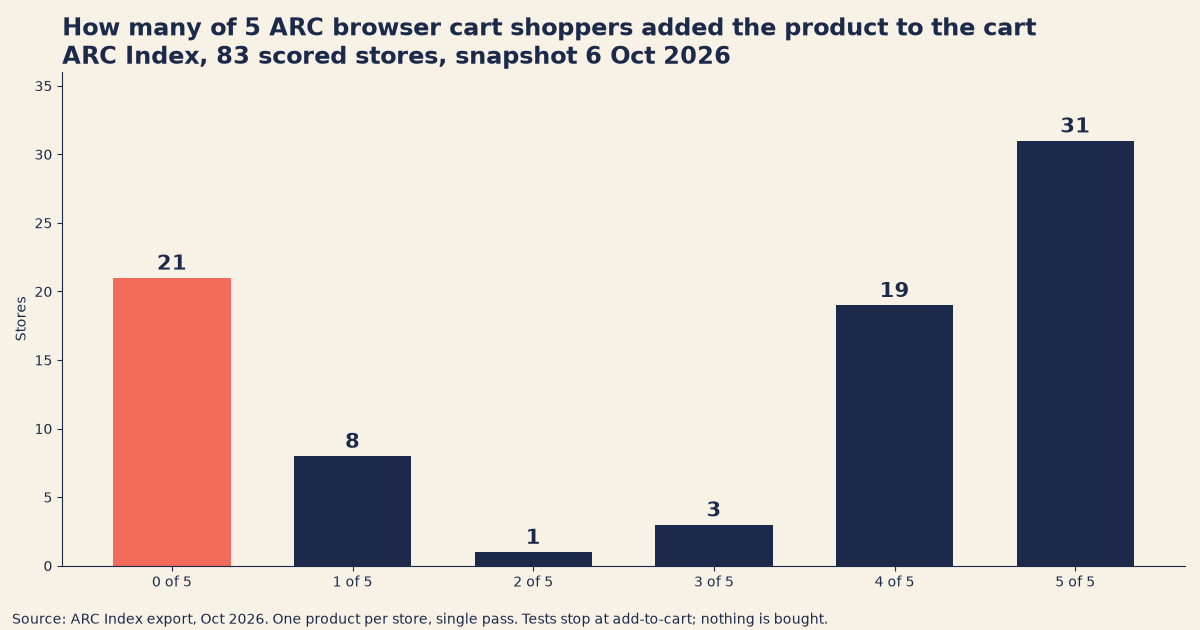
ARC tested 83 online stores on the ARC Index between 5 and 6 October 2026. Five ARC browser cart shoppers tried to add one named product to the cart at each store. At a quarter of the stores, none of them managed it.
The short version
- Of 83 stores scored on the ARC Index in October 2026, 62 (75%) had at least one of five ARC browser cart shoppers add the product to the cart, and 31 (37%) had all five do it.
- Of 83 stores scored on the ARC Index in October 2026, 21 (25%) had no ARC browser cart shopper reach add-to-cart.
- Of the 21 ARC Index stores where 0 of 5 ARC browser cart shoppers added the product to the cart, 14 still returned an agent checkout link over HTTP. The agent rails said yes; the storefront said no.
- Of the 52 scored ARC Index stores where at least one shopper failed to add to cart, 39 were stopped at the add-to-cart step itself, 8 at the size or colour picker, 3 by a human-check and 2 by a bot block at the door.
- Of 261 storefronts ARC checked for Personal Agent Protocol (PAP) discovery markers on 6 October 2026, 0 showed one. That is expected: the v0.1 spec isn't published yet.
Finding 1: lead with "x of 5", not the score
Because Index tests stop at add-to-cart, the practical ceiling of ARC's 0–100 Index score is 86. Scores bunch at a few values (28 of 83 stores sit at exactly 86, 17 at 35 and 14 at 83). The median is 83, with quartiles at 40 and 86. The clearer number is how many of the five ARC browser cart shoppers added the product to the cart (n = 83 scored stores):
| Shoppers that added to cart | Stores |
|---|---|
| 5 of 5 | 31 |
| 4 of 5 | 19 |
| 3 of 5 | 3 |
| 2 of 5 | 1 |
| 1 of 5 | 8 |
| 0 of 5 | 21 |
31 stores worked for every shopper, 31 for some, and 21 for none. Stores where all five shoppers added to cart include Allbirds, Glossier, Everlane, Rare Beauty, OLIPOP, Parachute, Huel and Vessi. The full list is on the ARC Index.
Finding 2: most stops happen at the add-to-cart button
At 52 of 83 scored stores, at least one shopper did not add the product to the cart. ARC publishes one stop reason per store, with evidence:
| Published stop reason (n = 52 stores) | Stores |
|---|---|
| Couldn't add it to the cart | 39 |
| Blocked at the size picker | 8 |
| Stopped by a human-check | 3 |
| Store blocks automated agents at the door | 2 |
The published evidence shows what got in the way. In 10 of the 52 stores, a pop-up covered the add-to-cart button. Five of those were SMS sign-up offers ("Sign Up via Text for Offers"). In 5 stores, the shopper clicked add-to-cart and the cart did not change. In 6 of the 8 size-picker stops, every size or colour option showed as disabled or sold out to the shopper. That can mean a picker agents can't read, or real stock on the tested product at test time. Four stop details were ARC's own test errors, which ARC doesn't blame on the store.
The 21 stores with 0 of 5 break down the same way: 12 couldn't add to cart, 4 were blocked at the size picker, 3 hit a human-check and 2 blocked automated agents at the door.
One more signal: the shopper persona built as a scripted crawler, which is weak on JavaScript-heavy pages, added to cart at 35 of 83 stores. The four model-driven personas managed 50 to 57. Add-to-cart flows that depend heavily on JavaScript lose the simplest agents first.
Finding 3: categories differ, but the samples are small
Only categories with at least 10 scored stores are compared here. Footwear has 8 and is left out.
| Category | Scored stores | 5 of 5 | 0 of 5 | Median score |
|---|---|---|---|---|
| Apparel | 24 | 7 | 7 | 68 |
| Beauty | 17 | 7 | 4 | 83 |
| Food & drink | 13 | 5 | 3 | 79 |
| Home | 11 | 5 | 1 | 83 |
| Supplements | 10 | 4 | 2 | 83 |
Apparel had the highest share of stores where no shopper reached add-to-cart (7 of 24) and the lowest median score. Home had the lowest share (1 of 11). At these sample sizes, treat this as an early signal.
The gap: the agent rails say yes, the storefront says no
ARC tests two lanes and reports them separately. The agent-catalog check is a plain HTTP request to a store's Shopify storefront catalog (MCP) endpoints. It asks for the tested product and a checkout link, and places no order. The ARC browser cart test opens the product page in a real browser.
Of 83 scored stores, 63 returned an agent checkout link over HTTP:
- 49 returned a checkout link and had at least one browser shopper add to cart
- 14 returned a checkout link while 0 of 5 browser shoppers added to cart
- 13 had browser success but no checkout link (in 7 of them, the catalog answered but didn't return the tested product)
- 7 had neither
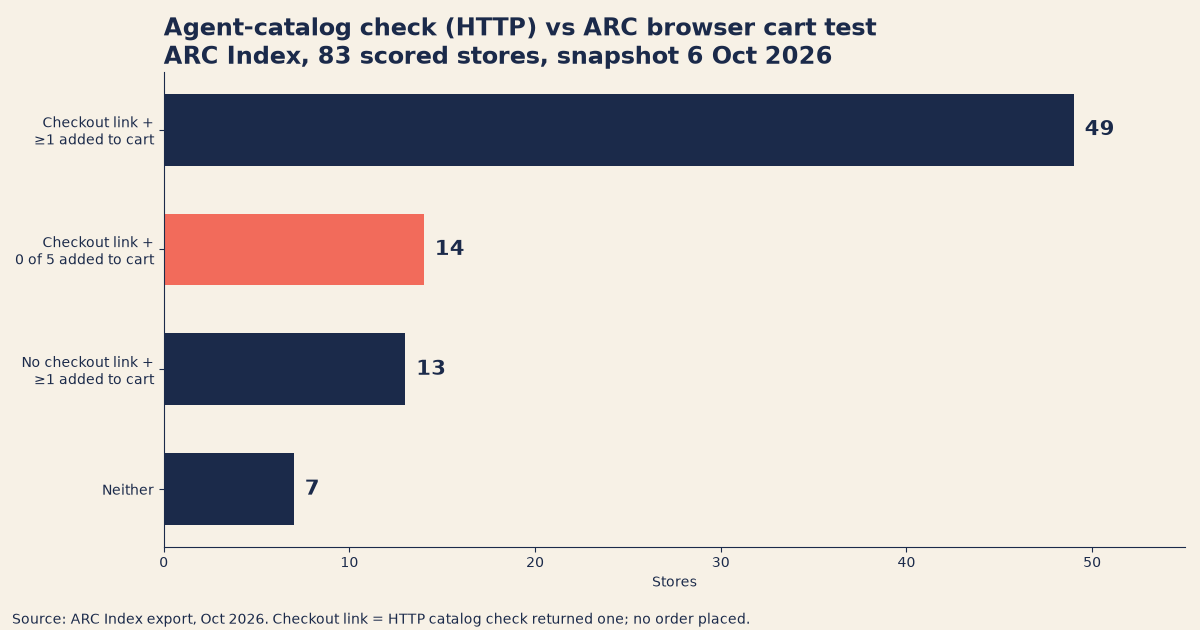
The 14 gap stores are spread across beauty (4), footwear (3), apparel (3), food and drink (2), home (1) and supplements (1). All 14 publish a valid Universal Commerce Protocol (UCP) profile. Their published stops: 8 couldn't add to cart, 4 were blocked at the size picker, 2 hit a human-check. In 5 of the 14, a pop-up covered the add-to-cart button.
A working agent catalog doesn't mean a working storefront. An agent using the catalog may get a checkout link, while an agent shopping the page like a person never gets the product into the cart.
PAP: early detection, zero markers so far
On 6 October 2026, Sierra and Meta announced the Personal Agent Protocol, an open standard for how personal agents interact with businesses. Sierra says it plans to publish the v0.1 specification later this month (Sierra, "Introducing Personal Agent Protocol").
ARC probes each storefront's homepage and six candidate well-known paths for PAP discovery markers. On 6 October 2026, all 261 domains showed "Watching for PAP v0.1", with 0 candidate markers, as expected before a spec exists. This is a watch lane, not a support claim.
What brands should do
Every item below maps to a failure seen in this data:
- Keep pop-ups off the add-to-cart button. Pop-ups caused 10 of the 52 published stops. Delay email and SMS capture on product pages, or keep it out of the buy box, and make sure it has a plain close button.
- Make add-to-cart change the cart. In 5 stores, the click did nothing visible. Use a standard add-to-cart form, and show the cart state change on the page.
- Make variants machine-readable. Use labelled size and colour inputs, keep in-stock options enabled, and preselect an in-stock variant where it makes sense.
- Reduce JavaScript dependence in the buy box. The scripted crawler persona managed 35 of 83 stores, against 50 to 57 for the model-driven personas.
- Decide on bot rules deliberately. 5 scored stores stopped shoppers with a human-check or a door block before the cart. Across all 261 domains, ARC observed block risk at 18.
- Test both lanes. If your catalog returns a checkout link, don't assume the storefront works too: 14 stores had one and still got 0 of 5. Also check that your catalog search returns your products. At 10 scored stores, the catalog answered but didn't return the tested product.
Methodology and limits
- Sample: 261 domains. 89 are ARC Index stores, and 83 of them have a published score. 6 are unscored ("Retest pending" or "No retest is scheduled"), and a missing score is not a zero. The other 172 are directory storefronts with only the agent-catalog check. Across all 261, 157 returned a checkout link.
- Single pass, one product per store. Tests ran over about 42 hours on 5–6 October 2026 (snapshot 6 October, 22:20 Dublin). This is ARC's first report, so there's no history and no trend yet.
- Category skew. Apparel is 24 of 83 scored stores, and most of the sample is DTC brands on Shopify. This is not a representative sample of all ecommerce.
- ARC browser cart test, not live agents. All five shoppers are personas running on the same low-cost model. This is ARC's own browser cart test, not a live Muse, Instinct, ChatGPT, Grok or OpenClaw session. Index tests stop at add-to-cart, and nothing is bought. "Finished the purchase" on the Index means all five added to cart.
- The catalog check only works for Shopify-style catalogs. "No agent catalog" on another platform doesn't mean agents can't buy there.
- Reachability: "Allow vs block" is Unknown for 243 of 261 domains. Google AI Mode cells are Inferred from a valid UCP profile (178 domains) or Unknown, and never Measured.
The full method is on the methodology page and in How ARC tests whether agents can buy from your store.
Check your own store
Run a free scan at arcreport.ai to see your score, where shoppers stopped, and what to fix. Then open your store hub at arcreport.ai/store for your Reachability Matrix, PAP watch status and Index result.
ARC is independent and not affiliated with Meta, Sierra, Shopify or any agent vendor.
HOW ARC MEASURES THIS
Scores come from ARC's own browser cart test and a real HTTP check of the store's agent catalog. Neither is a live session of a named personal agent. Read the full methodology.